 by Robin Chapman The Half Glass-for Will Some see it half empty, some half full. This one you bring to me Is half of the glass of beer we agreed to share, Poured into glasses the cheerful waitress has sized to fit. Our two half-glasses I see have become, Like this late life with you, not a test of temperament But the doubled gift Of a full glass for each. -From Love and Lust Anthology, Parallel Press (2011) -Originally appeared in BabelFruit (2009) | |
2/14/2011


2/12/2011
American Life in Poetry: Column 306
BY TED KOOSER, U.S. POET LAUREATE, 2004-2006
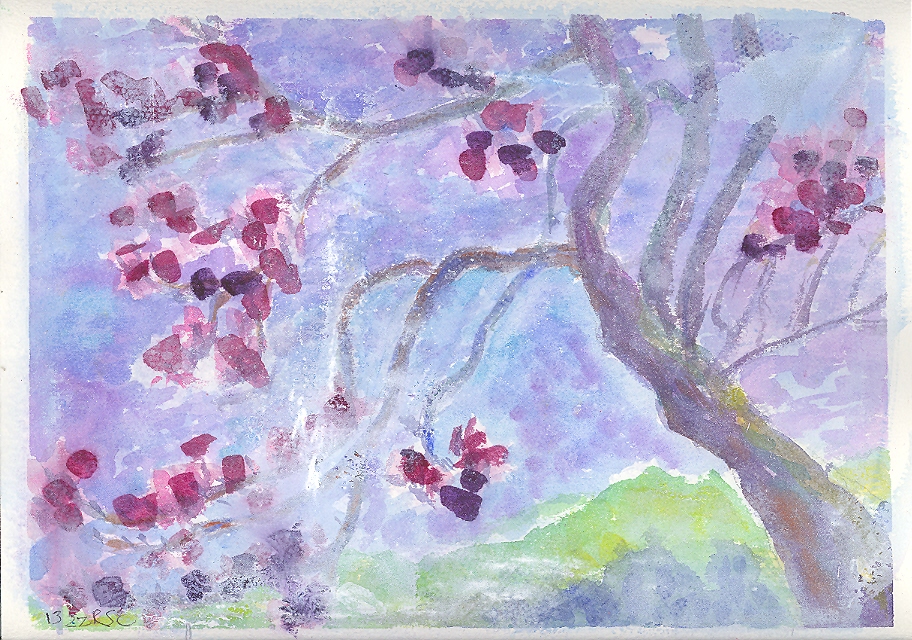
My grandmother Moser made wonderful cherry pies from fruit from a tree just across the road from her house, and I have loved fruit trees ever since. A cherry tree is all about giving. Here’s a poem by Nathaniel Perry, who lives in Virginia, giving us an orchard made of words.
Remaking a Neglected Orchard
It was a good idea, cutting away
the vines and ivy, trimming back
the chest-high thicket lazy years
had let grow there. Though it wasn’t for lack
of love for the trees, I’d like to point out.
Years love trees in a way we can’t
imagine. They just don’t use the fruit
like us; they want instead the slant
of sun through narrow branches, the buckshot
of rain on these old cherries. And we,
now that I think on it, want those
things too, we just always and desperately
want the sugar of the fruit, the best
we’ll get from this irascible land:
sweetness we can gather for years,
new stains staining the stains on our hands.
American Life in Poetry is made possible by The Poetry Foundation, publisher of Poetry magazine. It is also supported by the Department of English at the University of Nebraska-Lincoln. Poem copyright ©2010 by Nathaniel Perry, and reprinted from Gettysburg Review, Vol. 23, no. 1, Spring 2010, by permission of Nathaniel Perry and the publisher. The introduction's author, Ted Kooser, served as United States Poet Laureate Consultant in Poetry to the Library of Congress from 2004-2006. We do not accept unsolicited manuscripts.
******************************
1/24/2011

American Life in Poetry: Column 305
BY TED KOOSER, U.S. POET LAUREATE, 2004-2006
The great Spanish artist Pablo Picasso said that, in his subjects, he kept the joy of discovery, the pleasure of the unexpected. In this poem celebrating Picasso, Tim Nolan, an attorney in Minneapolis, says the world will disclose such pleasures to us, too, if only we pay close attention.
Picasso
How can we believe he did it—
every day—for all those years?
We remember how the musicians
gathered for him—and the prostitutes
arranged themselves the way he wanted—
and even the helmeted monkeys
with their little toy car cerebella—
posed—and the fish on the plate—
remained after he ate the fish—
Bones—What do we do with this
life?—except announce: Joy.
Joy. Joy—from the lead—
to the oil—to the stretch of bright
canvas—stretched—to the end of it all.
American Life in Poetry is made possible by The Poetry Foundation, publisher of Poetry magazine. It is also supported by the Department of English at the University of Nebraska-Lincoln. Poem copyright ©2008 by Tim Nolan, whose most recent book of poetry is The Sound of It, New Rivers Press, 2008. Poem reprinted from Water~Stone Review, Vol. 11, Fall 2008, by permission of Tim Nolan and the publisher. The introduction's author, Ted Kooser, served as United States Poet Laureate Consultant in Poetry to the Library of Congress from 2004-2006. We do not accept unsolicited manuscripts.*****************************
12/12/2010
By Don Colburn: How to Say Kwakiutl

by Don Colburn
HOW TO SAY KWAKIUTL
Imagine a grizzly bear
with frogs in its ears and a raven
perched on its head. It helps
to have watched a great heron
at the ragged edge of the sea
before it flaps and somehow
lifts off. Or if, in the dark,
you can make out a yellow cedar
bending to the water – maybe.
Like the wind, the rain, the rings
in the treetrunk the great bear
was carved from, or a sound
you hear for the first time, so old
you know it tells more than one
story: Quawquawkeewogwah.
No use squinting at the scant
letters or sounding them out.
Listen to one who hears his name
without looking. Close your eyes.
Say what he knew by heart.
(from As If Gravity Were a Theory, Cider Press Review, 2006).
12/11/2010

American Life in Poetry: Column 287
BY TED KOOSER, U.S. POET LAUREATE, 2004-2006
I love to sit outside and be very still until some little creature appears and begins to go about its business, and here is another poet, Robert Gibb, of Pennsylvania, doing just the same thing.
For the Chipmunk in My Yard
I think he knows I’m alive, having come down
The three steps of the back porch
And given me a good once over. All afternoon
He’s been moving back and forth,
Gathering odd bits of walnut shells and twigs,
While all about him the great fields tumble
To the blades of the thresher. He’s lucky
To be where he is, wild with all that happens.
He’s lucky he’s not one of the shadows
Living in the blond heart of the wheat.
This autumn when trees bolt, dark with the fires
Of starlight, he’ll curl among their roots,
Wanting nothing but the slow burn of matter
On which he fastens like a small, brown flame.
BY TED KOOSER, U.S. POET LAUREATE, 2004-2006
I love to sit outside and be very still until some little creature appears and begins to go about its business, and here is another poet, Robert Gibb, of Pennsylvania, doing just the same thing.
For the Chipmunk in My Yard
I think he knows I’m alive, having come down
The three steps of the back porch
And given me a good once over. All afternoon
He’s been moving back and forth,
Gathering odd bits of walnut shells and twigs,
While all about him the great fields tumble
To the blades of the thresher. He’s lucky
To be where he is, wild with all that happens.
He’s lucky he’s not one of the shadows
Living in the blond heart of the wheat.
This autumn when trees bolt, dark with the fires
Of starlight, he’ll curl among their roots,
Wanting nothing but the slow burn of matter
On which he fastens like a small, brown flame.
******************************
12/10/2010

by John L. Campbell
INSOMNIA
Chocolate coated vowels in four letter verbs
traipse across my bedroom ceiling, Gaelic
conjugations, St. Michael with muddy feet.
With my eyes closed it’s so quiet I hear
my soft slippers whispering to sandals
under my bed, KEENS itching for a walk.
They swap the smell of their souls, tongues
flap behind loose laced lips, tread rugs,
carpet, and ceramic tile where their steps
leave tracks on abrasive roads, trace
rubber and leather, one by man, one by God.
Y does a melt-down miffed at not being
voted the sixth vowel, tracking in sticky
dark chocolate, words reading, “Get up,
grab a pencil n’ pad, jot this down.”
-First published in Verse Wisconsin Issue # 104 October 2010
12/02/2010

American Life in Poetry: Column 285
BY TED KOOSER, U.S. POET LAUREATE, 2004-2006
In our busy times, the briefest pause to express a little interest in the natural world is praiseworthy. Most of us spend our time thinking about other people, and scarcely any time thinking about other creatures. I recently co-edited an anthology of poems about birds, and we looked through lots of books and magazines, but here is a fine poem we missed, byTara Bray, who lives in Richmond, Virginia.
Once
I climbed the roll of hay to watch the heron
in the pond. He waded a few steps out,
then back, thrusting his beak under water,
pulling it up empty, but only once.
Later I walked the roads for miles, certain
he’d be there when I returned. How is it for him,
day after day, his brittle legs rising
from warm green scum, his graceful neck curled,
damp in the bright heat? It’s a dull world.
Every day, the same roads, the sky,
the dust, the barn caving into itself,
the tin roof twisted and scattered in the yard.
Again, the bank covered with oxeye daisy
that turns to spiderwort, to chicory,
and at last to goldenrod. Each year, the birds—
thick in the air and darting in wild numbers—
grow quiet, the grasses thin, the light leaves
earlier each day. The heron stood
stone-still on my spot when I returned.
And then, his wings burst open, lifting the steel-
blue rhythm of his body into flight.
I touched the warm hay. Hoping for a trace
of his wild smell, I cupped my hands over
my face: nothing but the heat of fields
and skin. It wasn’t long before the world
began to breathe the beat of ordinary hours,
stretching out again beneath the sky.
American Life in Poetry is made possible by The Poetry Foundation, publisher of Poetry magazine. It is also supported by the Department of English at the University of Nebraska-Lincoln. Poem copyright ©2006 by Tara Bray, and reprinted from her most recent book of poems, Mistaken for Song, Persea Books, Inc., 2009, by permission of the publisher. Introduction copyright ©2010 by The Poetry Foundation. The introduction's author, Ted Kooser, served as United States Poet Laureate Consultant in Poetry to the Library of Congress from 2004-2006. We do not accept unsolicited manuscripts.
***************
Subscribe to:
Posts (Atom)

 Posts
Posts


